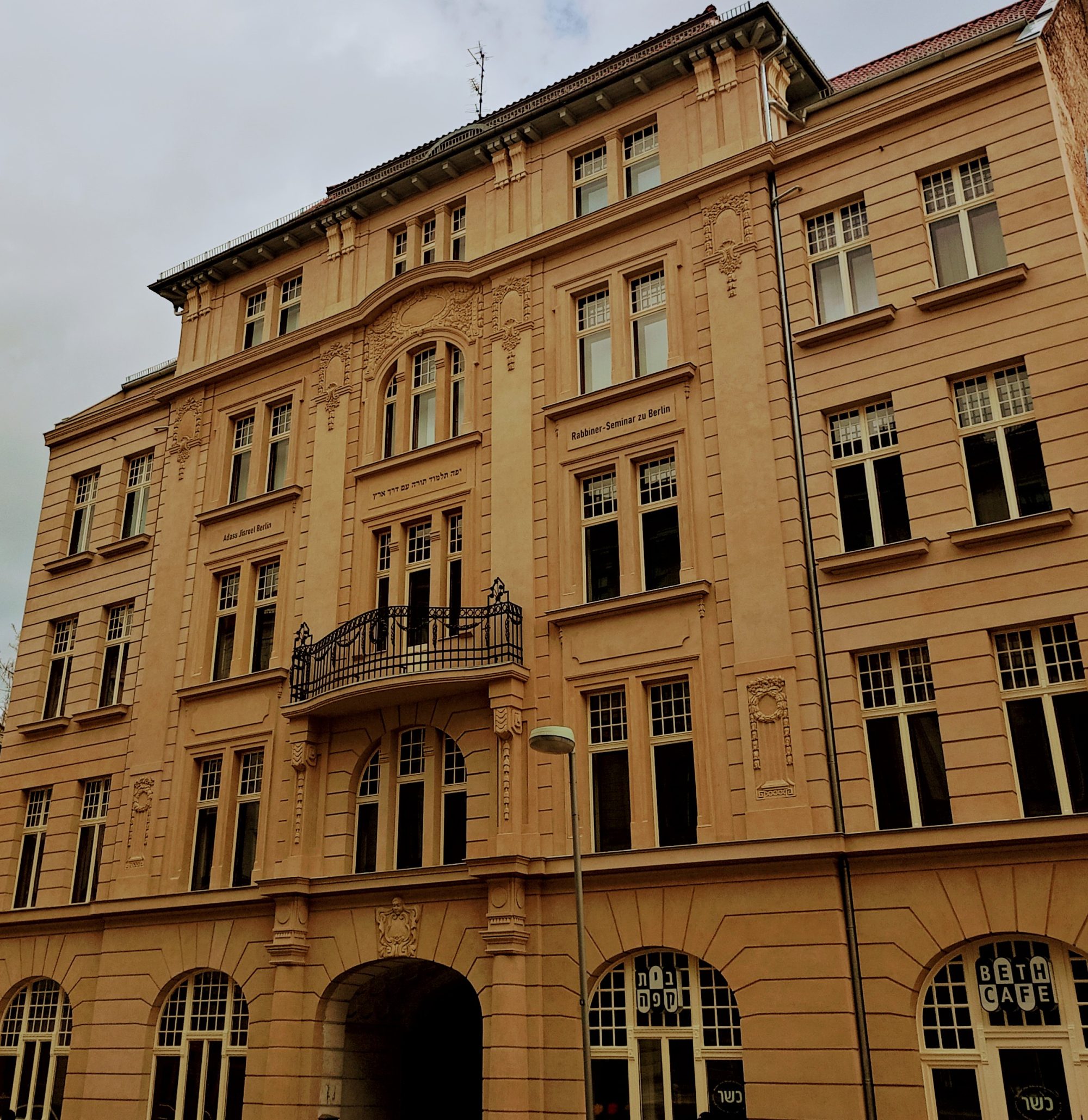

A publicly funded project presenting Jewish history in Berlin has come under criticism for almost completely omitting central institutions of Jewish life in the historic Scheunenviertel district.
The project “Spurlos verschwunden? – Jewish Life in the Heart of Berlin before the Nazi Dictatorship” is carried out by the Stiftung Neue Synagoge Berlin – Centrum Judaicum in cooperation with the Mitte Museum and is funded through the Berlin Senate’s Action Fund for Projects Against Antisemitism. The district administration of Berlin-Mitte also supports the project. Its stated aim is to make Jewish life in the historic Scheunenviertel visible.
However, a review of the publicly available content reveals a striking historical omission:
The Israelitische Synagogen-Gemeinde (Adass Jisroel) of Berlin – hereafter the Jewish Community Adass Jisroel – which played a central religious and institutional role in the Scheunenviertel and the Spandauer Vorstadt in the nineteenth and early twentieth centuries – is not presented, it was ‘trotzkied away’.
The name “Adass Jisroel” appears only once in the digital presentation, and solely as the designation of a building (“Synagogue Adass Jisroel”). The community itself, its institutions, its rabbis, its schools, and its importance for the religious and social life of a significant portion of the Jewish population of the district remain unmentioned.
Likewise absent is any reference to the Rabbinical Seminary of Berlin, historically closely intertwined with the community and located in the same building complex (then Artilleriestraße 31, today Tucholskystraße 40). This institution was internationally recognised as one of the leading centers for Orthodox rabbinical scholarship.
Yet historical documentation clearly shows that a significant portion of the kosher infrastructure of the Scheunenviertel operated under the rabbinical supervision of Adass Jisroel, and that Orthodox families from the district sent their children to the community’s schools. The rabbinical court of Adass Jisroel was regarded as the highest halachic authority for the Orthodox population of the Scheunenviertel.
Without these religious and institutional structures, the Jewish everyday life of this district cannot be historically understood.
The community stated:
“A project intended to combat antisemitism that omits Jewish history fails its mission.”
The matter gains additional political significance because the Berlin Senate itself is currently the subject of a parliamentary inquiry concerning the allocation of cultural funding. The Jewish Community Adass Jisroel has informed the parliamentary inquiry committee of the Berlin House of Representatives about this issue.
In Berlin, a bad tradition is being cultivated: Already in 1997, Germany’s Federal Administrative Court confirmed the legal continuity and identity of the Jewish Community Adass Jisroel and rejected the position previously taken by the State of Berlin that the community had ceased to exist after its destruction during the Nazi period.
As a result, Adass Jisroel remains the only Jewish community in Germany whose institutional identity and legal continuity from the nineteenth century have been preserved.
Against this background, the community asks how Jewish history is presented in publicly funded projects – and what responsibility public institutions bear when they finance projects intended to combat antisemitism.