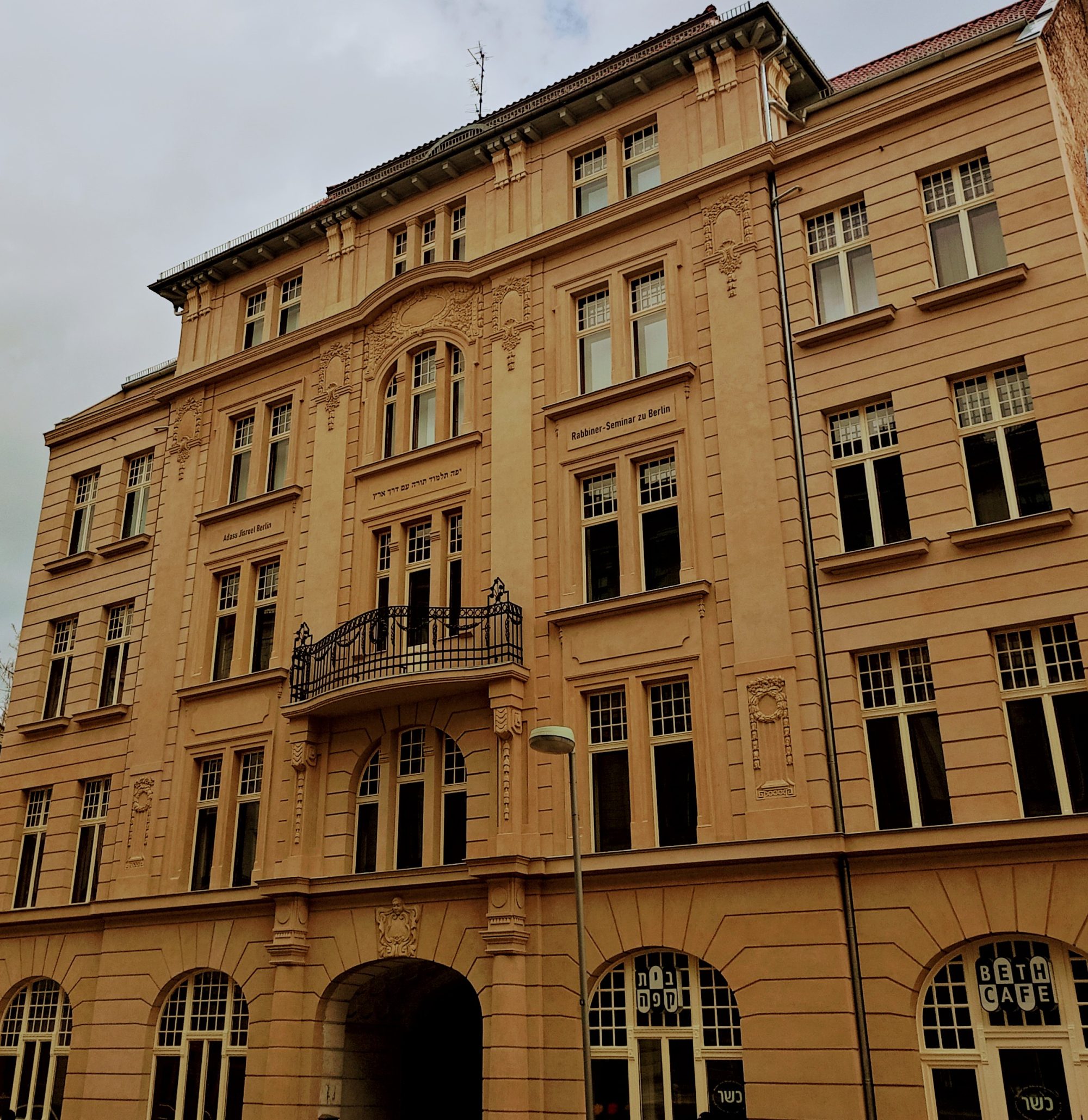

When around 160,000 Jews lived in Berlin – many of them for several
generations, with so few of their descendants still living here today – and when
Berlin still had a reasonably accessible housing market, many Jewish families
chose their homes not only according to location and rent. What could matter
just as much was whether the property management would permit a Sukkah to
be put up on the balcony or in a courtyard of the rented property. For Adassian
families, this was simply taken for granted. This is how the tradition was passed
down to us.
But why is putting up one’s own Sukkah so important, when there are also
several beautiful and welcoming communal Sukkot where one can visit from
time to time during certain opening hours?
The fulfilment of the commandment of the Sukkah is comprehensive. Unlike
many other Mitzvot, which are fulfilled through one particular attitude or a
specific action, the Sukkah completely surrounds the person – with his whole
body and throughout his entire existence, throughout the day: while eating,
while resting, while living. Were it not somewhat pleonastic, one could almost
describe the Sukkah as a halachic institution par excellence.
Just as the Sukkah opens its roof so that, through the green covering, we can
directly experience the starry sky and thus Creation itself, so too the philosophy
of our community stands for a Torah-observant Judaism that does not close
itself off from secular scholarship and education, from art and culture. This is
what we call the synthesis of tradition and modernity.
Leaving the solid and secure house for an often windy, sometimes cosy, but
always temporary leafy hut makes clear that true protection does not depend
on earthly architecture or material wealth. This teaches us humility.
Pausing in the temporary hut during Sukkot grounds us in our everyday lives.
The Sukkah thus becomes a symbol of Jews who are rooted in the modern
world, aware of its transience, and who live their Judaism quite naturally. This is
what we call: The Temporary and the Eternal.
Shabbat Shalom and Chag Sukkot Sameach!