
On Rosh Hashanah, the Yom HaDin, the shofar is sounded. This year, it will be sounded only on the second day, since the first day is Shabbat. The shofar is not an instrument of gentle sounds; it is a wake-up call that stirs the soul – this is how Jewish tradition has described it throughout the ages.
This year, that sound mingles with a very worldly shock: the result of the state election in Saxony-Anhalt, in which a party that has become the strongest political force has also fueled resentment, trivialized the genocide of six million Jews (the Holocaust), and threatens democratic culture. For us, this is not an abstract concern. It understandably awakens real and historically deep-seated fears about the future of Jewish life in this country. Where is our security? How do we preserve our identity?
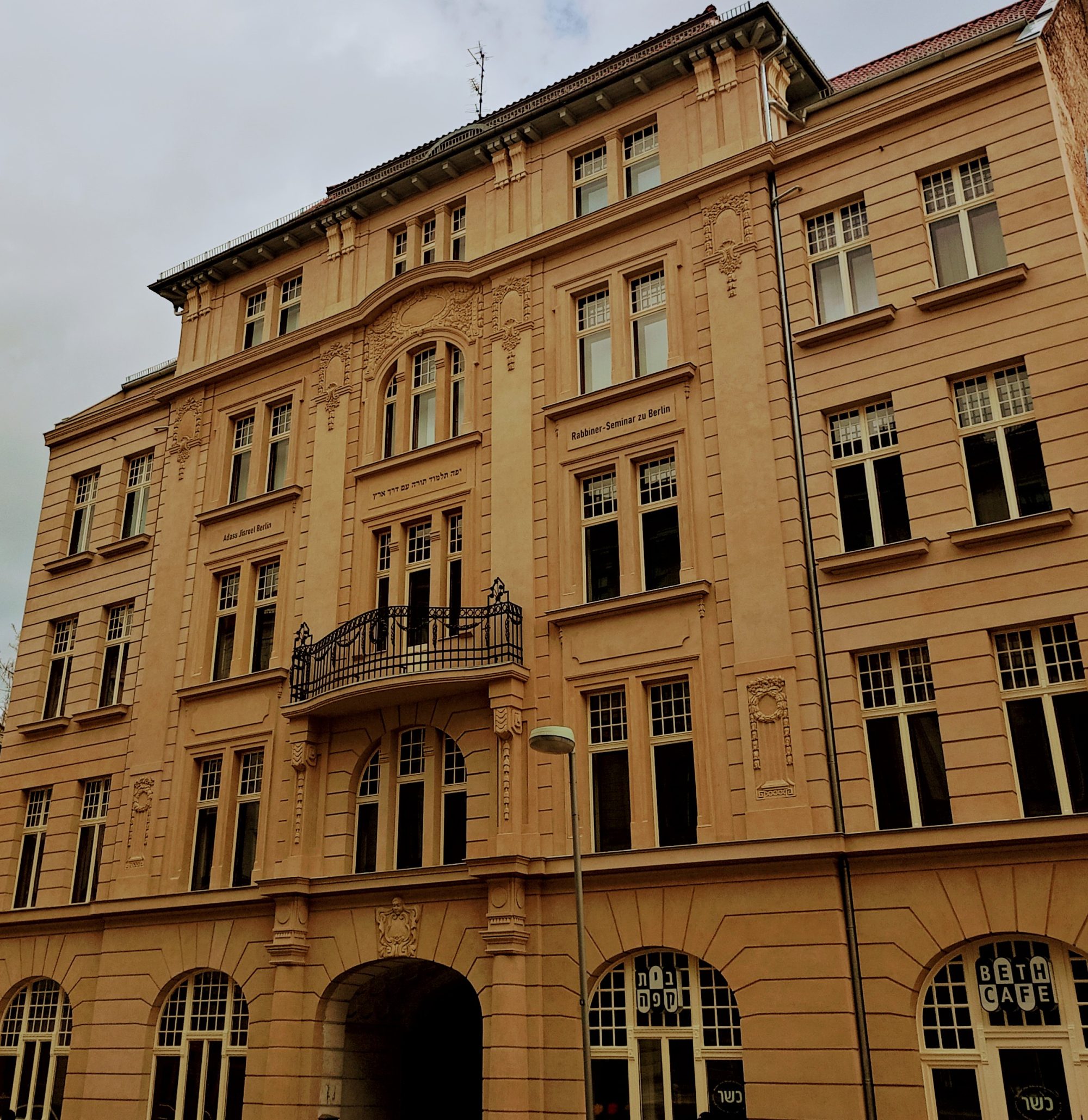
Our own community, Adass Jisroel, has unfortunately had to answer such questions before. In 1869, around 100 Jewish families in Berlin founded their own Torah-observant community. They appointed Rabbi Dr. Esriel Hildesheimer זצוק”ל of Eisenstadt as their first rabbi and spiritual guide. His life’s work was built upon a teaching from Pirkei Avot: יָפֶה תַלְמוּד תּוֹרָה עִם דֶּרֶךְ אֶרֶץ – “Beautiful is the study of Torah combined with the demands of the times” (Pirkei Avot 2:2). These words can still be read on the façade of our community centre on what is today Tucholskystrasse, then known as Artilleriestrasse. For Rabbi Esriel Hildesheimer, this meant participation in society, yes – but never at the expense of Jewish substance. When modern antisemitism flared up in Berlin, he did not respond by withdrawing, but by building strong, independent Jewish institutions.
His successor, Rabbi Esriel Hacohen Munk זצ”ל, stood in the midst of the storms of the Weimar Republic. When the antisemitic agitator Theodor Fritsch used fabricated Talmud quotations to spread anti-Jewish hatred, Munk did not remain silent: in 1924, he published the polemical work “False Talmud Quotations” and confronted the slander with clear knowledge. He showed us and German society that one does not approach those in authority or the public submissively, but with dignity – and takes an unequivocal stand. We have remembered this.
Rabbi Avraham Eliyahu Kaplan זצ”ל, who in 1920 unfortunately assumed the co-leadership of our rabbinical seminary for only a very short time and died in 1924 at the age of just 34 – he lies in our cemetery in Weissensee, not far from Rabbi Hildesheimer – devoted his life’s work to יראה (Jirah), reverence
for G’tt. For him, Jirah was not a paralyzing fear, but an alert awareness of the presence of the Eternal in the midst of everyday life. This is precisely the inner attitude that carries us through the Yom HaDin: not fear of the world, but reverence for G’tt. This is what Rosh Hashanah celebrates.
Governments and political parties may appear powerful for the moment – we must not lose sight of their power – but they do not have the final word in history. Jewish continuity reaches further.
We do not enter the new Jewish year 5787 naively. The concerns of Jews in Germany are real, and they must be heard by the entire democratic society. Antisemitism is not the problem of the Jews; it is a problem of society, which must fight it and banish it from its midst.
The shofar that we sound on this festival proclaims neither capitulation nor surrender, but resilience, hope, and Jewish continuity. Adass Jisroel was once destroyed, and yes, we rebuilt it – this fact is at the same time our obligation for the coming year.
Leschana Towa Tikatewu weTechatemu – may you be inscribed and sealed for a good year!